
Dogfy Diet’s conversion funnel
Project overview
Dogfy Diet is a subscription brand for fresh, natural dog food, and this project focused on redesigning its core acquisition funnel: a guided nutritional assessment that collects key pet attributes and feeds them into an algorithm to generate a personalized feeding plan and price. The flow ends on a personalized product page that reveals the dog’s recommended daily ration, tailored plan price and the path into checkout.
Client
Dogfy Diet
Year
2023
Category
Website design
Credits
Dogfy Diet's Product Team
Context
Dogfy Diet’s core funnel is a nutritional assessment that collects pet data (breed, age, weight, activity, health) to generate personalized feeding plans via algorithm. Operates with ~88% mobile traffic; Spain primary market, Italy/France secondary with high active users.
Challenge
Legacy flow wasn’t mobile-first, causing drop-offs at lead and payment despite users completing pet data willingly, hesitated when the experience suddenly felt like a “wall” of commitment.. Mandatory fields for algorithm and marketing made structural simplification difficult.
Goal
Increase CR and lead quality by reducing friction at critical lead/payment steps through mobile-first narrative design that builds trust and perceived value pre-commitment.
Key insights
Value clarity reduces price & trust friction
Front‑load concrete value (vet proof, social proof, clear trial/discount terms) to reframe price and lift lead + purchase intent.
Perceived effort matters more than step count
Chunk the flow, show live progress, and validate inline; this triggers the Endowed Progress / IKEA Effect, making users feel like co‑creators and keep going.
Lead‑gate stays → build value before asking
Frame the lead as the step to unlock a tailored plan; with dynamic copy (pet name/breed) and visible progress, Effort Justification increases post‑lead conversion.

Strategy
Radical mobile‑first: CTAs above the fold, minimal scrolling.
Modular, independent steps: reorder/test by country without touching the whole flow.
Storytelling + micro‑interactions: keep momentum and explain value in a friendly way.
Contextual microcopy: tackle objections exactly where they arise.
Visible progress: dynamic bar with clear “how much is left”.
Keep the lead‑gate & reveal price after lead: reinforce discount/savings and the personalized proposal; focus on building value pre‑lead.
Personalized copy via dynamic keys: use collected data (pet name and breed, age/size/goal) to auto‑personalize headlines and tips, increasing relevance and empathy.
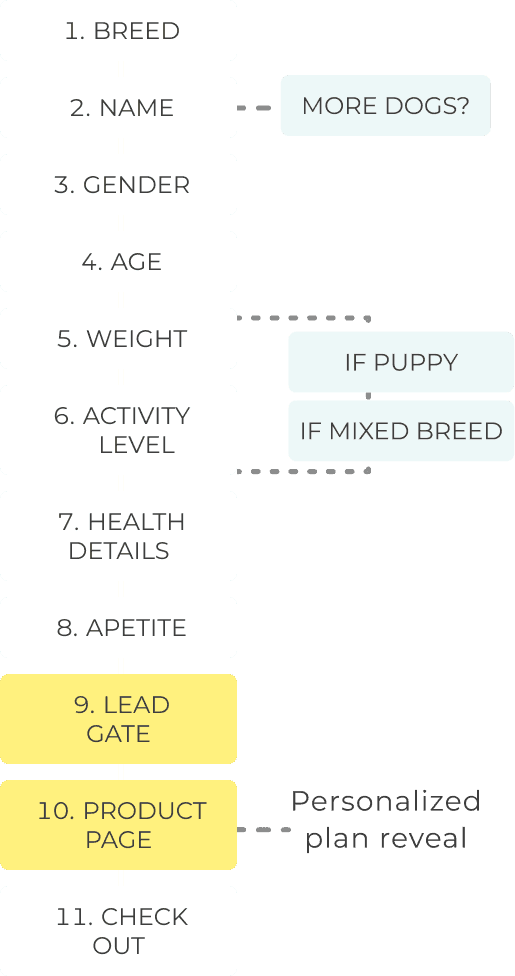
Flow overview
Personalization, storytelling, and micro-interactions drive conversion. Core value: progress tracking + contextual guidance.

Solution
Shortest path is ~11 steps to the purchase summary; complex profiles take 15–16 steps. Despite being longer than the legacy form, the storytelling and the feeling of actively customizing the plan keep users engaged and improve final conversion.
Step 1 - Breed

Step 2 - Dog´s name

Step 3 - Gender
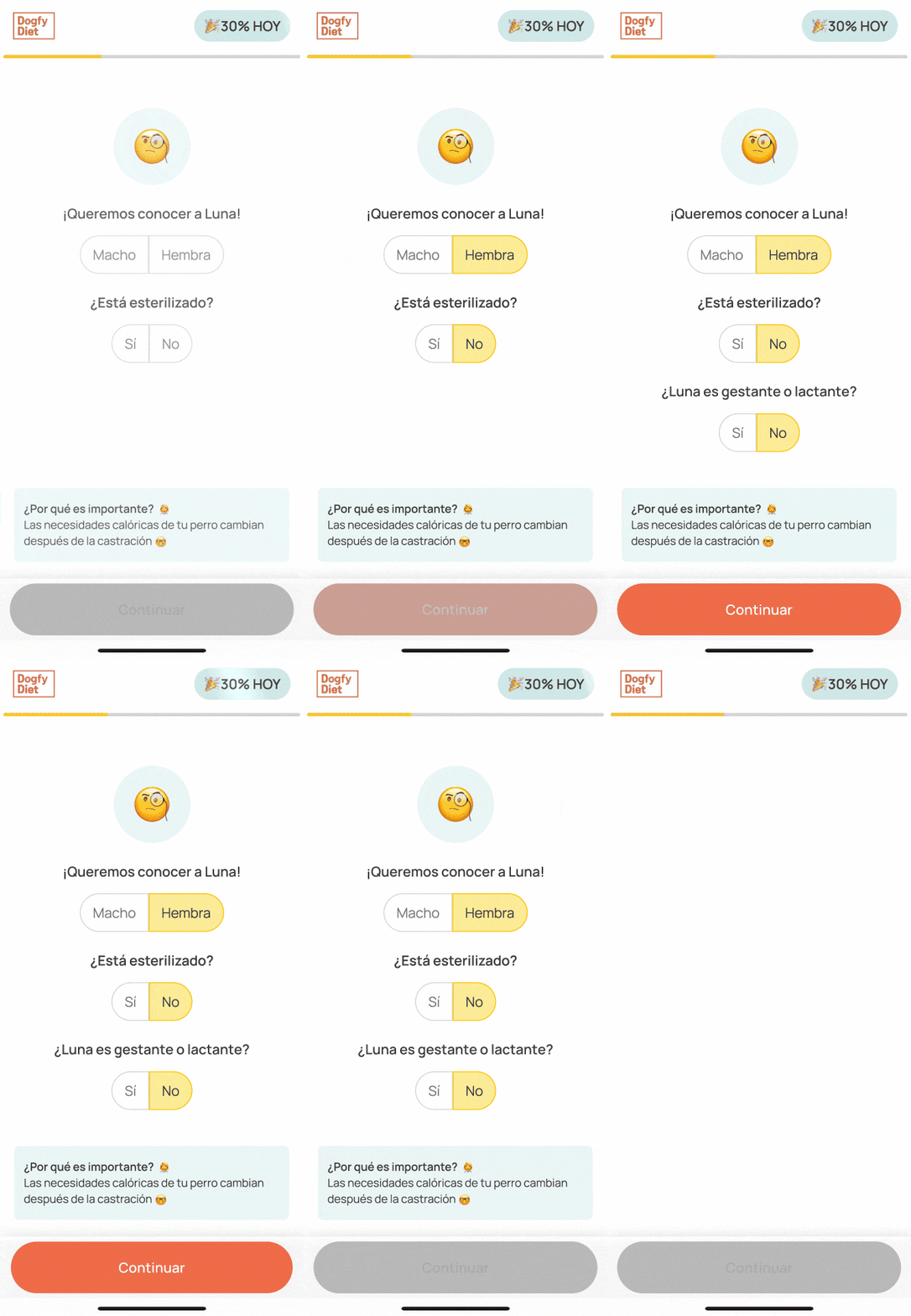
Step 4 - Age

Step 5 - Silhouette

Copy & Trust
Contextual tips on price/quality/vet endorsement/policies.
Dynamic‑key personalization (e.g., “Luna, this is your tailored plan” / “For a German Shepherd like Coco, we recommend…”) while keeping an educational, friendly tone.
“Why we ask this?” helper texts for sensitive fields.
Performance & Accessibility
Inline validation, clear empty states, accessible labels and visible focus.
Lightweight loads; micro‑interactions that don’t block the flow.
Step 6 - Activity level

Step 7 - Health
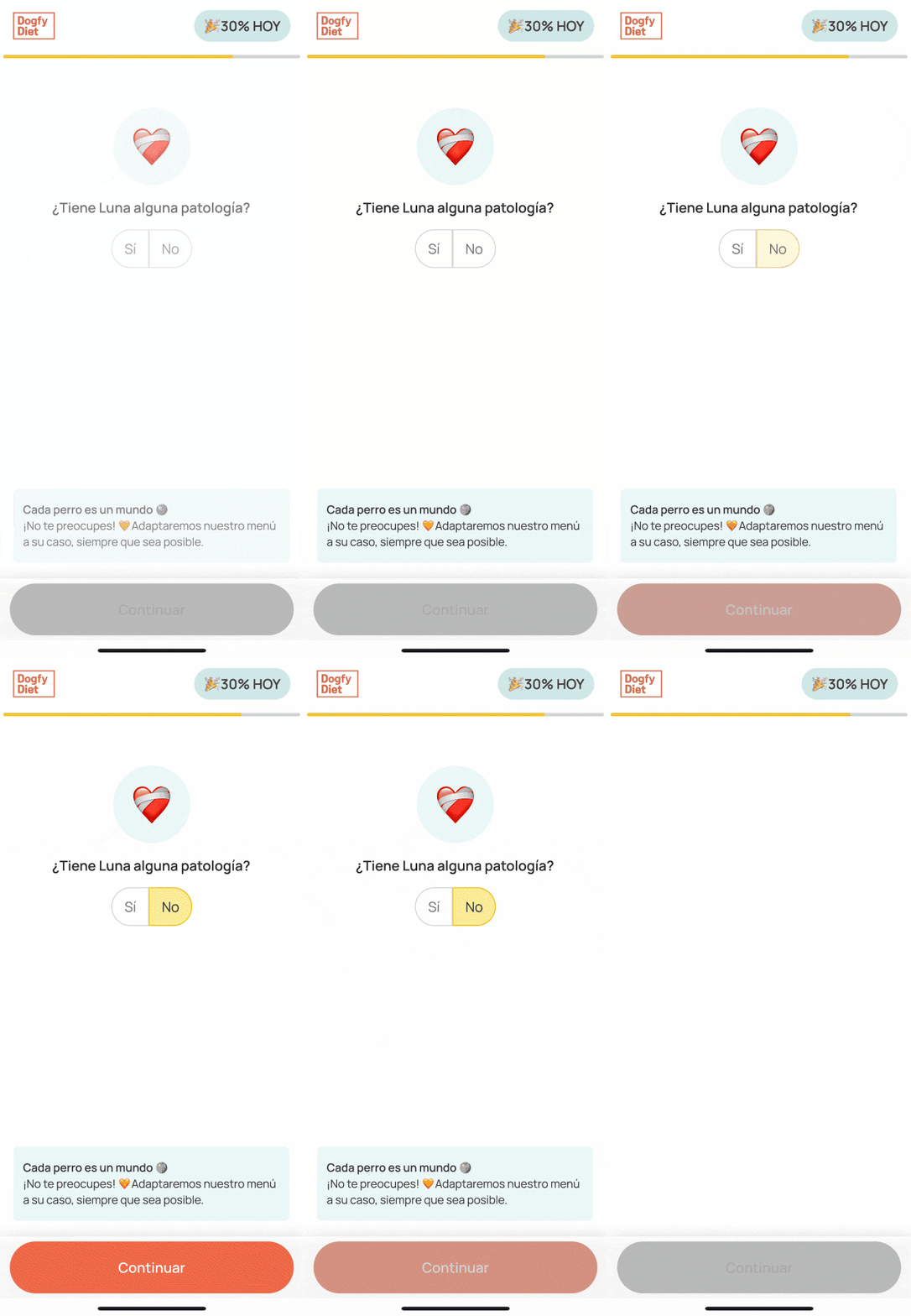
Step 8 - Apetite

Experimentation & measurement
Primary success: start→purchase.
Step‑level instrumentation (start, each step, lead, offer, checkout).
Planned per‑country iterations: step order, tips intensity, offer/savings variants, animations on/off.
Step 9 - Lead gate

Step 10 - Summary
Step 11 - Check out

Impact
Spain: 2.6% ➜ 11.6% CR.
Italy / France: ≥ 2× uplift vs. baseline.
Expected side effects:
↑ lead rate, ↓ total time, ↓ errors
Final step

Brand lift (perceived quality)
“Tailored plan” storytelling and micro‑interactions signal a more crafted and tech‑forward product.
Authority cues (nutritional messages and process explained) integrated as non‑intrusive tips at doubt points.
Lower emotional friction: empty states and empathetic microcopys.
Qualitative evidence: tests/feedback showed higher willingness to leave a lead and fewer repeated questions.
Quant indicators: ↑ interaction time in early steps; ↓ pre‑lead abandonment.
Learnings
“Longer ≠ worse: a longer but better‑narrated flow can outperform a shorter one when agency (co‑creation) and perceived value are high.
Educate early on subscription and value to reduce price/trust friction.
Visible progress + fast inputs reduce abandonment.
Even with the lead‑gate unchanged, better pre‑lead preparation improves willingness and purchase.

previous project
Next Project